How to Appeal a Family Court Decision in California

United States appellate procedure involves the rules and regulations for filing appeals in state courts and federal courts. The nature of an appeal can vary greatly depending on the type of instance and the rules of the court in the jurisdiction where the example was prosecuted. There are many types of standard of review for appeals, such as de novo and abuse of discretion. However, most appeals begin when a party files a petition for review to a higher court for the purpose of overturning the lower courtroom's determination.
An appellate courtroom is a court that hears cases on entreatment from some other court. Depending on the particular legal rules that apply to each circumstance, a political party to a court case who is unhappy with the issue might be able to challenge that result in an appellate court on specific grounds. These grounds typically could include errors of police force, fact, process or due procedure. In different jurisdictions, appellate courts are also called appeals courts, courts of appeals, superior courts, or supreme courts.
The specific procedures for appealing, including even whether in that location is a correct of appeal from a particular blazon of decision, can vary profoundly from state to state. The right to file an appeal can also vary from state to land; for example, the New Jersey Constitution vests judicial power in a Supreme Court, a Superior Court, and other courts of express jurisdiction, with an appellate court being office of the Superior Court.[i]
Access to appellant status [edit]
A party who files an appeal is called an "appellant", "plaintiff in fault", "petitioner" or "pursuer", and a party on the other side is chosen an "appellee". A "cross-appeal" is an appeal brought by the respondent. For instance, suppose at trial the gauge constitute for the plaintiff and ordered the defendant to pay $l,000. If the defendant files an entreatment arguing that he should not take to pay any coin, and so the plaintiff might file a cross-appeal arguing that the defendant should have to pay $200,000 instead of $l,000.
The appellant is the party who, having lost function or all their merits in a lower court conclusion, is appealing to a higher court to take their example reconsidered. This is usually done on the ground that the lower court judge erred in the application of constabulary, but it may also be possible to appeal on the basis of court misconduct, or that a finding of fact was entirely unreasonable to make on the evidence.
The appellant in the new case tin can be either the plaintiff (or claimant), accused, third-party intervenor, or respondent (appellee) from the lower case, depending on who was the losing political party. The winning political party from the lower court, yet, is now the respondent. In unusual cases the appellant can exist the victor in the court below, simply still entreatment.
An appellee is the party to an appeal in which the lower court judgment was in its favor. The appellee is required to answer to the petition, oral arguments, and legal briefs of the appellant. In general, the appellee takes the procedural posture that the lower court's decision should exist affirmed.
Power to appeal [edit]
An entreatment "every bit of right" is one that is guaranteed by statute or some underlying ramble or legal principle. The appellate court cannot refuse to listen to the appeal. An appeal "past go out" or "permission" requires the appellant to obtain leave to appeal; in such a situation either or both of the lower courtroom and the courtroom may have the discretion to grant or refuse the appellant'due south need to appeal the lower court's conclusion. In the Supreme Court, review in most cases is available but if the Courtroom exercises its discretion and grants a writ of certiorari.[2]
In tort, equity, or other civil matters either party to a previous case may file an appeal. In criminal matters, however, the state or prosecution generally has no appeal "every bit of right". And due to the double jeopardy principle, the state or prosecution may never appeal a jury or bench verdict of acquittal. But in some jurisdictions, the state or prosecution may entreatment "as of correct" from a trial courtroom's dismissal of an indictment in whole or in part or from a trial court'south granting of a defendant's suppression motion. Likewise, in some jurisdictions, the state or prosecution may appeal an issue of law "by leave" from the trial courtroom or the appellate court. The ability of the prosecution to appeal a decision in favor of a defendant varies significantly internationally.[3] All parties must present grounds to appeal, or information technology volition not be heard.
Past convention in some police force reports, the appellant is named first. This tin can mean that where it is the accused who appeals, the name of the example in the police reports reverses (in some cases twice) as the appeals work their fashion up the court bureaucracy. This is not ever truthful, notwithstanding. In the federal courts, the parties' names ever stay in the same order as the lower court when an appeal is taken to the circuit courts of appeals, and are re-ordered only if the entreatment reaches the Supreme Court.[ citation needed ]
Directly or collateral: Appealing criminal convictions [edit]
Many jurisdictions recognize two types of appeals, peculiarly in the criminal context.[four] [v] [6] The first is the traditional "straight" appeal in which the appellant files an appeal with the next higher court of review. The 2d is the collateral appeal or post-conviction petition, in which the petitioner-appellant files the appeal in a court of showtime case—unremarkably the courtroom that tried the case.
The key distinguishing cistron betwixt straight and collateral appeals is that the former occurs in state courts, and the latter in federal courts.[ dubious ]
Relief in mail service-confidence is rare and is most often found in capital or trigger-happy felony cases. The typical scenario involves an incarcerated defendant locating DNA bear witness demonstrating the defendant's bodily innocence.
Appellate review [edit]
"Appellate review" is the general term for the process past which courts with appellate jurisdiction take jurisdiction of matters decided by lower courts. It is distinguished from judicial review, which refers to the court's overriding ramble or statutory right to make up one's mind if a legislative act or administrative conclusion is defective for jurisdictional or other reasons (which may vary by jurisdiction).
In most jurisdictions the normal and preferred way of seeking appellate review is by filing an entreatment of the final judgment. Generally, an entreatment of the judgment will also allow entreatment of all other orders or rulings made by the trial court in the course of the instance. This is because such orders cannot exist appealed "as of correct". Nonetheless, sure critical interlocutory court orders, such as the denial of a request for an interim injunction, or an social club holding a person in contempt of courtroom, can be appealed immediately although the case may otherwise not take been fully disposed of.
In that location are 2 singled-out forms of appellate review, "straight" and "collateral". For example, a criminal defendant may exist convicted in state court, and lose on "directly appeal" to higher state appellate courts, and if unsuccessful, mount a "collateral" activity such as filing for a writ of habeas corpus in the federal courts. More often than not speaking, "[d]irect appeal statutes afford defendants the opportunity to claiming the merits of a judgment and allege errors of police force or fact. ... [Collateral review], on the other mitt, provide[s] an contained and civil inquiry into the validity of a confidence and judgement, and every bit such are more often than not limited to challenges to constitutional, jurisdictional, or other primal violations that occurred at trial." "Graham v. Borgen", 483 F 3d. 475 (7th Cir. 2007) (no. 04–4103) (slip op. at 7) (citation omitted).
In Anglo-American mutual law courts, appellate review of lower court decisions may likewise be obtained by filing a petition for review by prerogative writ in certain cases. There is no corresponding correct to a writ in any pure or continental civil police legal systems, though some mixed systems such every bit Quebec recognize these prerogative writs.
Straight appeal [edit]
After exhausting the get-go appeal as of correct, defendants commonly petition the highest state court to review the decision. This appeal is known equally a direct entreatment.[7] The highest land courtroom, generally known as the Supreme Court, exercises discretion over whether it volition review the case. On direct appeal, a prisoner challenges the grounds of the conviction based on an error that occurred at trial or some other stage in the adjudicative process.
Preservation issues [edit]
An appellant's claim(s) must commonly be preserved at trial. This ways that the accused had to object to the fault when it occurred in the trial. Because constitutional claims are of great magnitude, appellate courts might be more lenient to review the merits even if information technology was not preserved. For case, Connecticut applies the following standard to review unpreserved claims: 1.the tape is adequate to review the declared claim of error; 2. the claim is of ramble magnitude alleging the violation of a fundamental correct; 3. the alleged constitutional violation conspicuously exists and clearly deprived the defendant of a fair trial; 4. if bailiwick to harmless mistake analysis, the state has failed to demonstrate harmlessness of the alleged constitutional violation beyond a reasonable dubiousness.[eight]
State post-conviction relief: collateral appeal [edit]
All States have a post-conviction relief process. Similar to federal post-conviction relief, an appellant tin petition the court to correct declared fundamental errors that were not corrected on direct review.[nine] Typical claims might include ineffective assistance of counsel and actual innocence based on new evidence. These proceedings are normally split up from the direct appeal, however some states allow for collateral relief to be sought on direct entreatment.[10] After direct appeal, the conviction is considered concluding. An entreatment from the post confidence courtroom proceeds just as a direct appeal. That is, it goes to the intermediate appellate court, followed by the highest court. If the petition is granted the appellant could be released from incarceration, the sentence could be modified, or a new trial could be ordered.[xi]
Habeas corpus [edit]
Detect of appeal [edit]
A "discover of appeal" is a form or certificate that in many cases is required to begin an appeal. The form is completed past the appellant or by the appellant'due south legal representative. The nature of this class tin can vary greatly from state to country and from court to courtroom inside a country.
The specific rules of the legal system will dictate exactly how the appeal is officially begun. For instance, the appellant might take to file the notice of appeal with the appellate court, or with the court from which the appeal is taken, or both.
Some courts have samples of a observe of entreatment on the court's own web site. In New Jersey, for example, the Administrative Part of the Court has promulgated a course of detect of appeal for employ by appellants, though using this exact form is non mandatory and the failure to utilize it is not a jurisdictional defect provided that all pertinent information is set along in whatever form of notice of appeal is used.[12]
The deadline for beginning an entreatment can often be very short: traditionally, it is measured in days, not months. This tin vary from country to country, as well as within a country, depending on the specific rules in force. In the U.S. federal courtroom system, criminal defendants must file a notice of appeal within x days of the entry of either the judgment or the order being appealed, or the right to appeal is forfeited.[thirteen]
Appellate procedure [edit]
Generally speaking the appellate courtroom examines the record of prove presented in the trial courtroom and the law that the lower court applied and decides whether that determination was legally sound or non. The appellate court will typically be deferential to the lower courtroom'south findings of fact (such as whether a accused committed a particular act), unless conspicuously erroneous, then will focus on the court'south awarding of the police to those facts (such as whether the deed plant past the court to accept occurred fits a legal definition at issue).
If the appellate courtroom finds no defect, it "affirms" the judgment. If the appellate courtroom does find a legal defect in the decision "below" (i.east., in the lower courtroom), information technology may "modify" the ruling to right the defect, or it may nullify ("reverse" or "vacate") the whole conclusion or any part of it. It may, in addition, ship the instance dorsum ("remand" or "remit") to the lower court for further proceedings to remedy the defect.
In some cases, an appellate court may review a lower courtroom decision "de novo" (or completely), challenging even the lower courtroom'due south findings of fact. This might be the proper standard of review, for example, if the lower court resolved the case past granting a pre-trial motion to dismiss or motion for summary judgment which is usually based only upon written submissions to the trial court and not on any trial testimony.
Some other situation is where appeal is by way of "re-hearing". Certain jurisdictions permit sure appeals to cause the trial to be heard afresh in the appellate court.
Sometimes, the appellate court finds a defect in the procedure the parties used in filing the appeal and dismisses the appeal without considering its merits, which has the same outcome as affirming the judgment below. (This would happen, for example, if the appellant waited too long, under the appellate court'southward rules, to file the entreatment.)
By and large, there is no trial in an appellate court, merely consideration of the record of the prove presented to the trial court and all the pre-trial and trial court proceedings are reviewed—unless the appeal is by way of re-hearing, new evidence will ordinarily simply be considered on appeal in "very" rare instances, for example if that fabric evidence was unavailable to a political party for some very significant reason such as prosecutorial misconduct.
In some systems, an appellate court will only consider the written determination of the lower court, together with any written evidence that was earlier that court and is relevant to the appeal. In other systems, the appellate court will normally consider the record of the lower court. In those cases the record will first be certified by the lower court.
The appellant has the opportunity to present arguments for the granting of the entreatment and the appellee (or respondent) can present arguments confronting information technology. Arguments of the parties to the entreatment are presented through their appellate lawyers, if represented, or "pro se" if the political party has not engaged legal representation. Those arguments are presented in written briefs and sometimes in oral argument to the court at a hearing. At such hearings each party is allowed a brief presentation at which the appellate judges enquire questions based on their review of the record below and the submitted briefs.
In an adversarial system, appellate courts practise not take the ability to review lower court decisions unless a party appeals information technology. Therefore, if a lower court has ruled in an improper style, or against legal precedent, that judgment will stand if not appealed – even if it might have been overturned on appeal.
The U.s. legal organisation more often than not recognizes ii types of appeals: a trial "de novo" or an appeal on the record.
A trial de novo is usually bachelor for review of informal proceedings conducted by some pocket-size judicial tribunals in proceedings that practice not provide all the procedural attributes of a formal judicial trial. If unchallenged, these decisions have the power to settle more than minor legal disputes in one case and for all. If a party is dissatisfied with the finding of such a tribunal, i mostly has the power to request a trial "de novo" past a courtroom of tape. In such a proceeding, all problems and evidence may be developed newly, as though never heard before, and i is not restricted to the evidence heard in the lower proceeding. Sometimes, however, the determination of the lower proceeding is itself admissible as evidence, thus helping to curb frivolous appeals.
In some cases, an application for "trial de novo" effectively erases the prior trial as if information technology had never taken place. The Supreme Court of Virginia has stated that '"This Court has repeatedly held that the effect of an appeal to circuit courtroom is to "annul the judgment of the inferior tribunal as completely as if there had been no previous trial."'[14] The but exception to this is that if a accused appeals a confidence for a crime having multiple levels of offenses, where they are bedevilled on a lesser offense, the appeal is of the lesser offense; the conviction represents an acquittal of the more than serious offenses. "[A] trial on the same charges in the excursion court does non violate double jeopardy principles, . . . subject only to the limitation that conviction in [the] commune court for an law-breaking lesser included in the one charged constitutes an amortization of the greater criminal offense, permitting trial de novo in the excursion court only for the bottom-included criminal offence."[15]
In an appeal on the tape from a conclusion in a judicial proceeding, both appellant and respondent are spring to base their arguments wholly on the proceedings and torso of evidence equally they were presented in the lower tribunal. Each seeks to evidence to the higher court that the consequence they desired was the just effect. Precedent and case law figure prominently in the arguments. In order for the appeal to succeed, the appellant must show that the lower courtroom committed reversible error, that is, an impermissible action by the court acted to cause a result that was unjust, and which would non have resulted had the court acted properly. Some examples of reversible error would be erroneously instructing the jury on the law applicable to the instance, permitting seriously improper statement by an chaser, admitting or excluding evidence improperly, interim exterior the court'south jurisdiction, injecting bias into the proceeding or appearing to practice so, juror misconduct, etc. The failure to formally object at the time, to what ane views as improper action in the lower court, may upshot in the affirmance of the lower courtroom's judgment on the grounds that one did not "preserve the consequence for entreatment" by objecting.
In cases where a judge rather than a jury decided bug of fact, an appellate court will apply an "abuse of discretion" standard of review. Under this standard, the appellate court gives deference to the lower courtroom's view of the evidence, and reverses its decision only if information technology were a clear corruption of discretion. This is usually divers every bit a decision outside the bounds of reasonableness. On the other hand, the appellate court usually gives less deference to a lower courtroom'due south decision on bug of law, and may reverse if it finds that the lower court practical the wrong legal standard.
In some cases, an appellant may successfully argue that the law under which the lower decision was rendered was unconstitutional or otherwise invalid, or may convince the higher courtroom to order a new trial on the basis that prove before sought was concealed or merely recently discovered. In the example of new testify, at that place must be a loftier probability that its presence or absenteeism would have made a textile deviation in the trial. Some other issue suitable for entreatment in criminal cases is effective assistance of counsel. If a defendant has been convicted and tin can prove that his lawyer did not adequately handle his instance and that in that location is a reasonable probability that the consequence of the trial would have been different had the lawyer given competent representation, he is entitled to a new trial.
A lawyer traditionally starts an oral argument to whatsoever appellate court with the words "May it please the court."
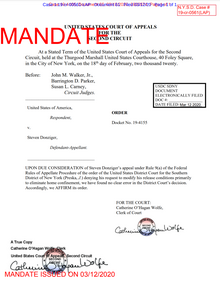
After an appeal is heard, the "mandate" is a formal discover of a decision by a court of entreatment; this notice is transmitted to the trial court and, when filed past the clerk of the trial courtroom, constitutes the final judgment on the instance, unless the appeal court has directed farther proceedings in the trial court. The mandate is distinguished from the appeal court's opinion, which sets out the legal reasoning for its conclusion. In some jurisdictions the mandate is known as the "remittitur".
Results [edit]
The consequence of an appeal tin be:
-
- Affirmed: Where the reviewing court basically agrees with the result of the lower courts' ruling(s).
- Reversed: Where the reviewing court basically disagrees with the result of the lower courts' ruling(s), and overturns their determination.
- Vacated: Where the reviewing court overturns the lower courts' ruling(s) as invalid, without necessarily disagreeing with information technology/them, due east.k. because the case was decided on the basis of a legal principle that no longer applies.
- Remanded: Where the reviewing court sends the case back to the lower courtroom.
There tin can exist multiple outcomes, then that the reviewing court tin assert some rulings, reverse others and remand the example all at the same time. Remand is not required where in that location is zip left to exercise in the case. "Generally speaking, an appellate courtroom's judgment provides 'the last directive of the appeals courts as to the affair appealed, setting out with specificity the court's determination that the action appealed from should exist affirmed, reversed, remanded or modified'".[16]
Some reviewing courts who have discretionary review may transport a instance back without comment other than review improvidently granted. In other words, after looking at the instance, they chose not to say anything. The event for the case of review improvidently granted is effectively the same as affirmed, only without that extra higher court stamp of approval.
Run across also [edit]
- Appellate court
- Appellee
- Ceremonious procedure
- Courtroom of Appeals
- Courts-martial in the United States
- Criminal procedure
- Defendant
- En banc
- Interlocutory entreatment
- Listing of legal topics
- List of wrongful convictions in the United States
- Petition for stay
- Plaintiff
- Pursuer
- Reversible error
- Supreme Court of the United States
- Writ of Certiorari
- Writ of habeas corpus
- Writ of mandamus
References [edit]
- ^ Jeffrey S. Mandel, New Jersey Appellate Practice (Gann Police Books), chapter 1:two
- ^ "U.S. Supreme Courtroom Rule x". Legal Information Institute.
- ^ "Consultation Newspaper on Prosecution Appeals Brought in Cases of Indictment". Police Reform Commission of Ireland. Archived from the original on November xix, 2007.
- ^ "UK Law Online". Academy of Leeds. Retrieved March 3, 2008.
- ^ "Special Habeas Corpus Procedures in Capital Cases". Usa Part of the Law Revision Counsel. Archived from the original on February 28, 2008. Retrieved March 3, 2008.
- ^ "Land of Ohio". Ohio 12th District Court of Appeals. Archived from the original on February 27, 2008. Retrieved 2008-03-03 .
- ^ Bickford, James. "Opinion Recap:All Judicial Review is either direct or collateral". Anti-Terrorism and Effective Death penalty Act. SCOTUS Bblog. Retrieved May 4, 2011.
- ^ Dauman, Chad. "Criminal Appeals in the United States: Preservation Issues". blog . Retrieved April 27, 2011.
- ^ Yackle, Larry (2003). Federal Courts, Habeas Corpus. Thomson Reuters.
- ^ "Archived copy" (PDF). Archived from the original (PDF) on February x, 2016. Retrieved Apr xi, 2016.
{{cite web}}: CS1 maint: archived re-create equally title (link) - ^ "Process For Post-Confidence Relief" (PDF). Oregon Department of Justice. Oregon Department of Justice. Archived from the original (PDF) on September 7, 2012. Retrieved April 27, 2011.
- ^ Jeffrey S. Mandel, New Jersey Appellate Do (Gann Law Books)
- ^ Rule 4(b)(one)(A)
- ^ "Gaskill 5. Commonwealth", 206 Va. 486, 490, 144 Due south.E.2d 293, 296 (1965)
- ^ "Kenyon v. Commonwealth", 37 Va. App. 668, 673, 561 S.East.2d 17, 19–twenty
- ^ State v. Randolph, 210 Northward.J. 330, 350 n.v (2012), citing Mandel, New Jersey Appellate Practise (Gann Law Books), chapter 28:2
External links [edit]
Source: https://en.wikipedia.org/wiki/Appellate_procedure_in_the_United_States
0 Response to "How to Appeal a Family Court Decision in California"
Post a Comment