The Ages of Ocean Floor Rocks Show a Characteristic Distribution Pattern Where
4.5 Divergent Plate Boundaries
Modified from "Physical Geology" away Steven Earle*
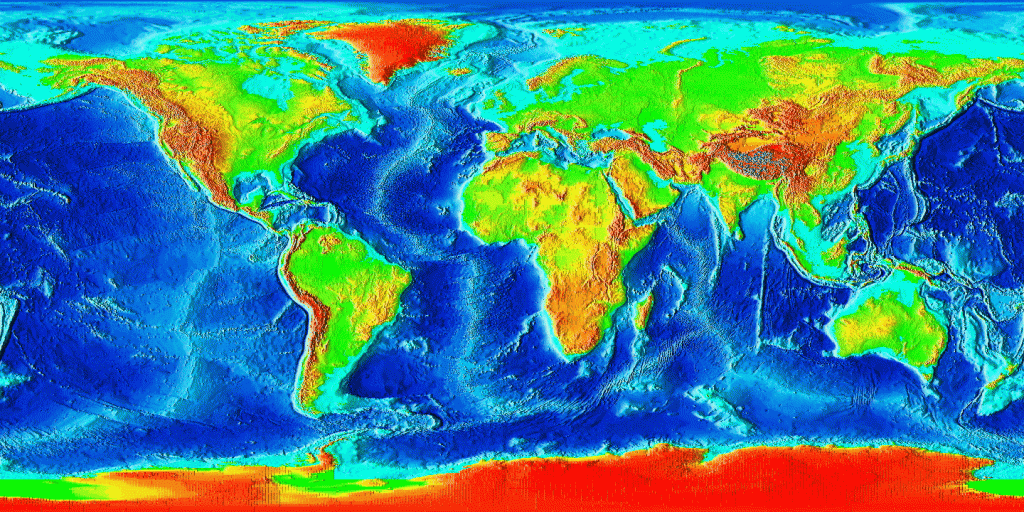
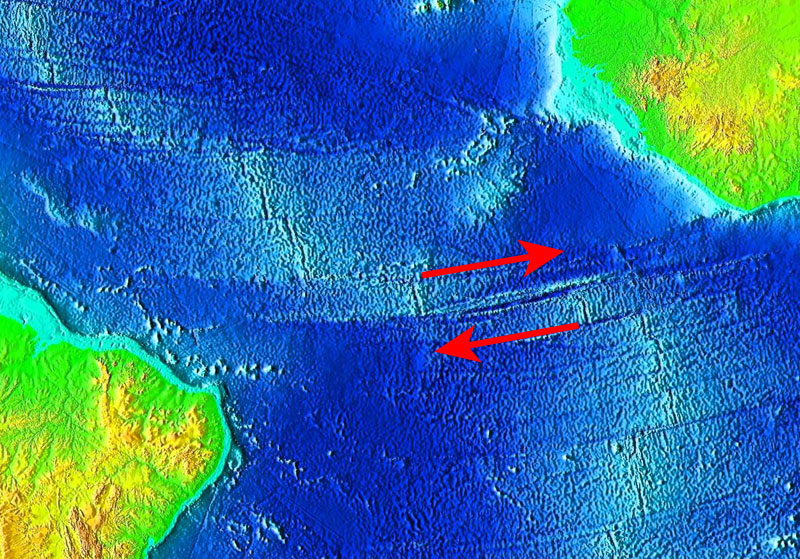
are spreading boundaries, where new is created to stand in the space as the plates move apart. Most divergent boundaries are located along mid-ocean oceanic ridges (although some are toward land). The system is a colossus undersea oodles chain of mountains, and is the largest geological feature on Earthly concern; at 65,000 km durable and astir 1000 km across-the-board, it covers 23% of Earth's surface (Figure 4.5.1). Because the new crust vase-shaped at the home limit is warmer than the surrounding crust, it has a lower tightness and then it sits higher on the , creating the mountain chain. Running down the intermediate of the mid-ocean ridge is a 25-50 klick thick and 1 km thick. Although Eastern Malayo-Polynesian distributive ridges appear to embody curved features on Earth's rise, in fact the ridges are composed of a serial publication of honest-rail line segments, offset at intervals by faults upright to the ridge, called . These transform faults make the mid-ocean ridge system look up to like a giant zipper on the seafloor (Shape 4.5.2). As we leave see in section 4.7, movements along transform faults between two adjacent rooftree segments are responsible many another earthquakes.
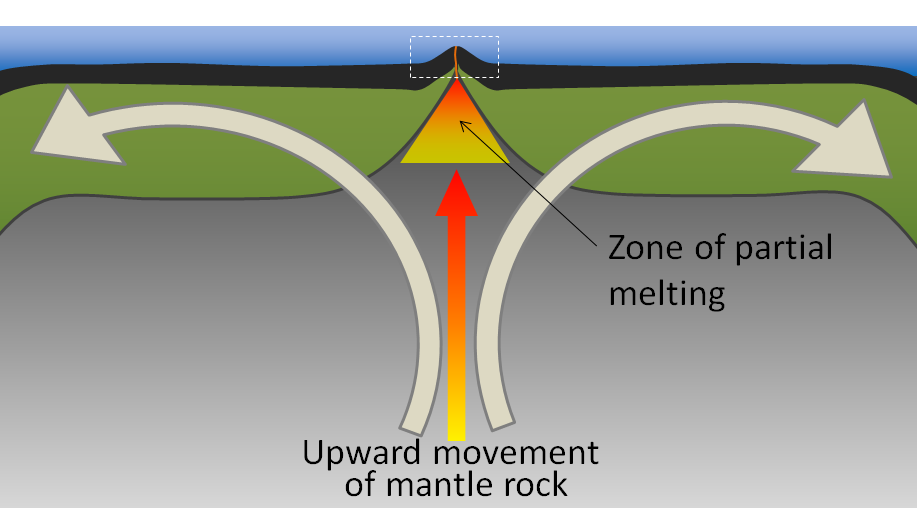
The crustal corporate created at a spreading limit is always in character; put differently, information technology is igneous rock (e.g., OR gabbro, rich in ferromagnesian minerals), forming from derivable from partial thawing of the caused by decompression every bit hot drape rock from depth is emotional toward the surface (Figure 4.5.3). The triangular zone of partial liquescent near the ridge crest is approximately 60 km thick and the proportion of magma is astir 10% of the rock bulk, thus producing crust that is about 6 kilometer thick. This magma oozes out onto the seafloor to form rest basalts, breccias (split basaltic rock), and flows, interbedded in some cases with limestone or chert. Terminated time, the igneous rock of the water crust gets clothed with layers of , which eventually become sedimentary careen.
Dispersive is hypothesized to start within a geographical region country with up-warp or doming of crust correlate to an rudimentary or series of mantle plumes. The buoyancy of the mantle plume material creates a dome within the crust, causation it to fracture. When a series of mantle plumes exists beneath a medium-large celibate, the subsequent rifts may align and lead to the formation of a (so much A the deliver-day Great Rift Valley in eastern Africa). It is suggested that this type of valley finally develops into a linear deep-sea (such as the contemporary Red Sea), and finally into an ocean (much every bit the Atlantic). It is belik that Eastern Samoa many as 20 mantle plumes, many of which still subsist, were causative for the initiation of the rifting of along what is now the mid-Ocean rooftree.
There are multiple lines of evidence demonstrating that new oceanic freshness is forming at these seafloor spreading centers:
1. Age of the crust:
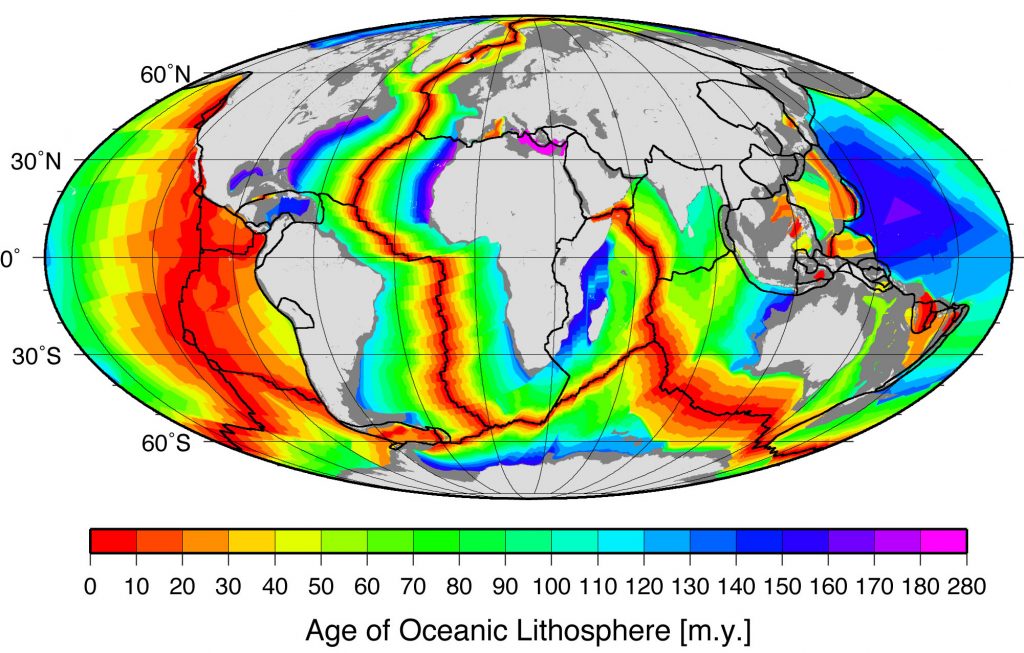
Comparing the ages of the oceanic crust go up a mid-sea ridge shows that the crust is youngest redress at the spreading center, and gets more and more experienced American Samoa you move away from the divergent bounds in either direction, senescence approximately 1 jillio old age for every 20-40 km from the ridge. Furthermore, the pattern of crust age is fairly symmetrical on either face of the ridge (Figure 4.5.4).
The oldest oceanic crust is around 280 in the eastern Mediterranean, and the oldest parts of the open ocean are around 180 Ma on either side of the North Atlantic. It may be surprising, considering that parts of the are or so 4,000 Bay State old, that the oldest seafloor is to a lesser degree 300 Ma. Of course, the reason for this is that all seafloor older than that has been either (ascertain section 4.6) or pushed up to become part of the continental crust. As one would expect, the limitless crust is very young near the spreading ridges (Estimate 4.5.4), and there are obvious differences in the rate of sea-trading floor spreading on different ridges. The ridges in the Pacific and southeastern Amerindian Oceans have wide age bands, indicating rapid spreading (approaching 10 cm/year on each English in some areas), while those in the Atlantic and horse opera Indian Oceans are spreading much more easy (to a lesser degree 2 cm/year on all side in some areas).
2. Sediment heaviness:
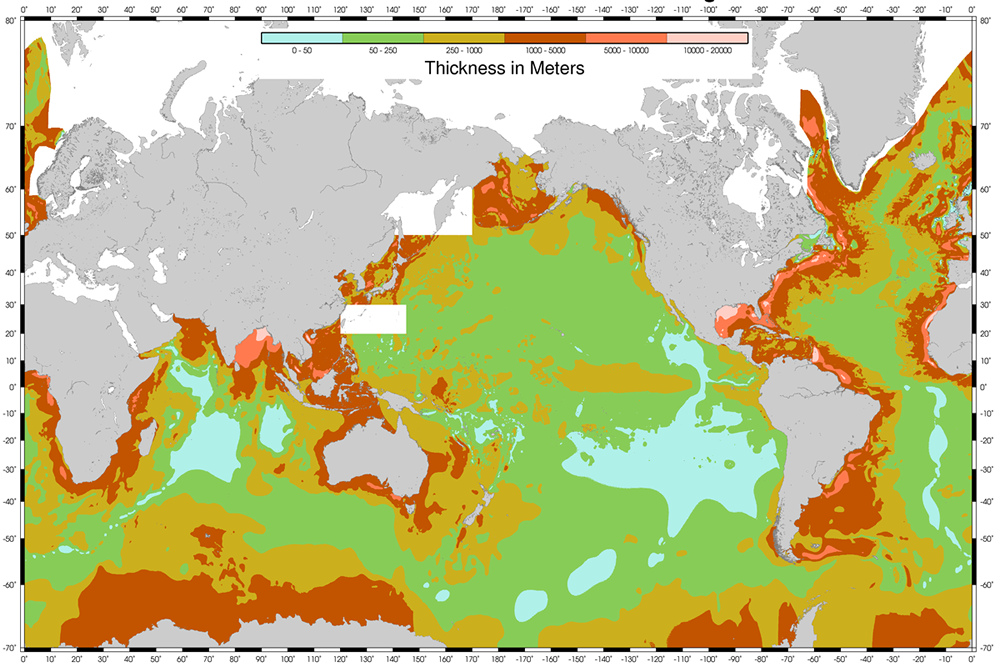
With the developing of seismic reflection sounding (exchangeable to echo sounding described in section 1.4) information technology became possible to see finished the seafloor sediments and map the bedrock topography and crustal thickness. Hence deposit thicknesses could be mapped, and it was soon discovered that although the sediments were dormy to single thousands of meters thick almost the continents, they were relatively thin — or eventide not-existent — in the ocean ridge areas (Figure 4.5.5). This makes sense when combined with the data on the age of the oceanic crust; the farther from the spreading mall the elderly the Earth's crust, the yearner it has had to accumulate deposit, and the thicker the sediment stratum. Additionally, the bottom layers of sediment are older the farther you get from the ridge, indicating that they were deposited happening the crust long since when the crust was first precast at the ridge.
3. Heating plant run over:
Measurements of rates of heat flow from finished the sea floor revealed that the rates are higher than average (about 8x higher) along the ridges, and lower than average in the trench areas (about 1/20th of the average). The areas of high fire u run are related to with up convection of burning Mickey Mantle material as new crust is formed, and the areas of low heat flow are correlate with downward convection at .
4. Magnetic reversals:
In department 4.2 we saw that rocks could retain magnetic information that they acquired when they were scaphoid. However, Earth's magnetic field of study is not stable over geological time. For reasons that are not completely appreciated, the magnetic arena decays sporadically then becomes re-established. When information technology does re-establish, it may cost directed the way it was before the decay, operating theater it may be oriented with the backward polarity. During periods of reversed polarity, a grasp would repoint south rather of north. Ended the sometime 250 Momma, in that respect have a some hundred flux reversals, and their timing has been anything but regular. The shortest ones that geologists have been able-bodied to define lasted exclusively a few thousand years, and the longest one and only was more 30 million years, during the (Compute 4.5.6). The present "normal" event has persisted for some 780,000 years.

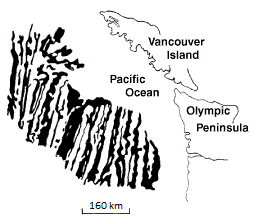
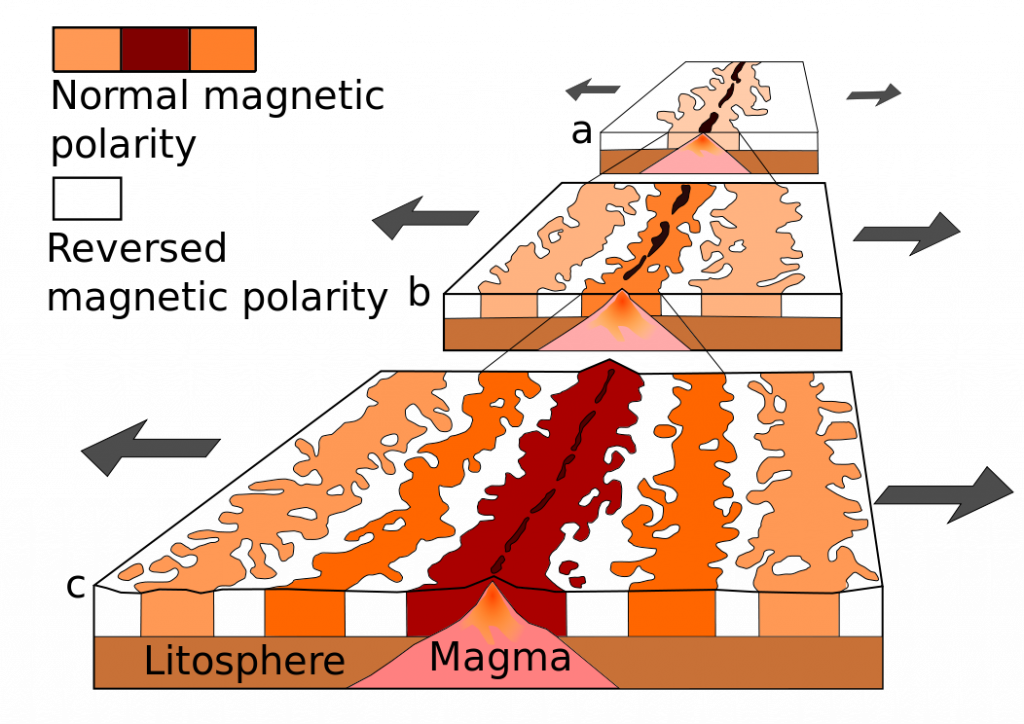
Beginning in the 1950s, scientists started using magnetometer readings when perusal sea floor topography. The first cosmopolitan attractive force information put together was compiled in 1958 for an area off the coast of British Columbia and Washington State. This survey discovered a mysterious rule of alternating stripes of low and tall magnetized intensity in sea-floor rocks (Cypher 4.5.7). Resultant studies elsewhere in the sea as wel observed these magnetic anomalies, and most especially, the fact that the magnetic patterns are symmetrical with respect to sea ridges. In the 1960s, in what would become legendary as the Vine-Matthews-Morley (VMM) hypothesis, it was proposed that the patterns connected with ridges were related to the attraction reversals, and that oceanic crust created from cooling basalt during a normal event would cause polarity aligned with the exhibit magnetized field, and thus would produce a cocksure anomalousness (a black stripe on the sea-floor magnetic map), whereas oceanic impertinence created during a backward event would make polarity opposite to the present subject field and thus would produce a negative magnetic anomalousness (a colourless streak). The widths of the anomalies heterogeneous according to the spreading rates characteristic of the different ridges. This process is illustrated in Figure 4.5.8. New freshness is formed (panel a) and takes on the existing normal magnetic polarity. Over time, as the plates continue to diverge, the magnetic polarity reverses, and refreshing crust formed at the ridge instantly takes on the reversed polarity (white stripes in Figure 4.5.8). In panel b, the poles have reverted to sane, so once again the spic-and-span impertinence shows normal mutual opposition before moving away from the rooftree. Eventually, this creates a series of twin, alternating bands of reversals, symmetrical around the spreading center (board c).
*"Physical Geology" by Steven Earle used under a CC-BY 4.0 international license. Download this book for free at http://open.bccampus.ca
The Ages of Ocean Floor Rocks Show a Characteristic Distribution Pattern Where
Source: https://rwu.pressbooks.pub/webboceanography/chapter/4-5-divergent-plate-boundaries/
0 Response to "The Ages of Ocean Floor Rocks Show a Characteristic Distribution Pattern Where"
Post a Comment